
AI Agents don’t “Google,” they fan-out.
Evidence has replaced ranking as the unit of value.

[Level: Easy. Slightly technical]
Search hasn’t disappeared, and SEO isn’t dead.
When marketers say “AI agents search with Google,” most imagine something simple:
An AI opens Google > types a query > clicks a few results > summarizes.
That’s not what’s happening.
Modern AI search systems, whether we’re talking about Google AI Mode, ChatGPT Search, Gemini grounding, or third-party agents, operate more like this:
Determine IF they are going to run a live search at all
Rewrite the user’s query
Break it into sub-questions
Run multiple searches (sometimes in parallel)
Select a small set of “trusted” pages
Extract core content
Synthesize an answer
Cite selectively (maybe)
Google even documents that AI Mode and AI Overviews can use “query fan-out”, issuing multiple related searches across subtopics and data sources while generating a response.
That changes everything: now you’re not competing for a click; you’re competing to be selected into the evidence set.
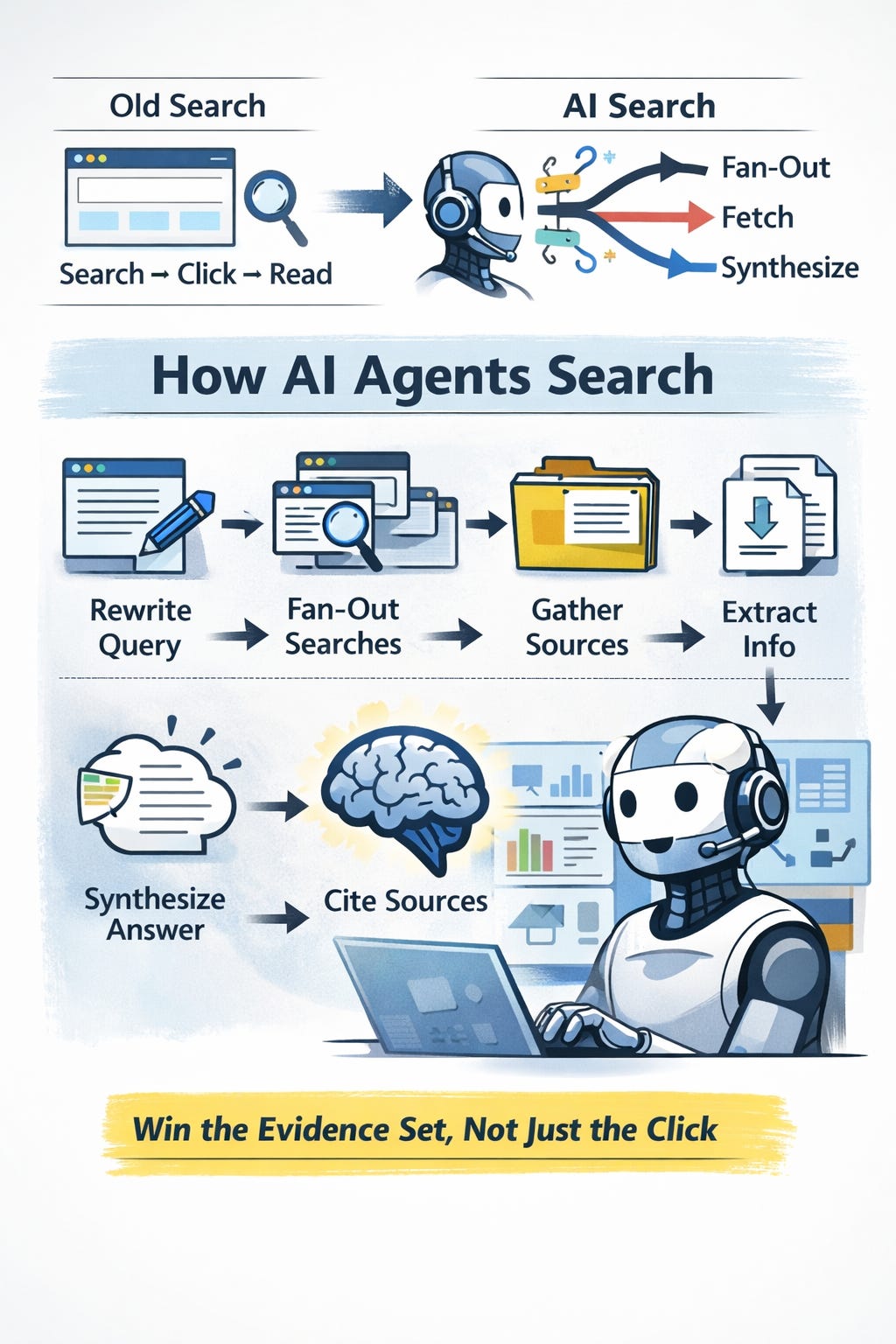
The Big Shift: From Rankings to Retrieval
Traditional SEO logic:
Rank #1 → Get clicks → Drive revenue.
AI Search logic:
Be retrievable → Be trusted → Be cited → Maybe get the click.
The “top result” is no longer the whole battlefield.
You can rank well and never be cited.
You can be cited and get fewer clicks.
You can influence the answer without appearing above the fold.
That’s a structural change, not a UX tweak.
What “Search With Google” Actually Means in 2026
There are three distinct pipes now.
1. Google Is the Agent
In AI Overviews and AI Mode, the AI is operating inside Google’s search infrastructure.
It can:
Fan-out into multiple related searches
Gather additional sources while generating
Present grouped citations alongside synthesized answers
Google has even been iterating link presentation to make source access more visible and easier to fact-check — a direct response to publisher pressure around traffic.
Implication:
You’re optimizing not just for ranking — but for being selected as corroborating evidence during generation.
2. Gemini Uses Google as a Tool
Developers can connect Gemini directly to Google Search via a grounding tool.
That means: Products across the web can embed Google search capabilities into their AI flows.
Every SaaS tool that adds “AI research mode” may effectively become another search surface pulling from Google’s index.
SEO is best thought of as core infrastructure
3. Not All Agents Use Google
ChatGPT Search rewrites prompts and sends targeted queries to search providers. Open-source agents often default to Brave Search. Some agents fetch and extract page content without executing JavaScript.
So you’re no longer optimizing for a single engine.
You’re optimizing for:
Google
Bing-powered systems
Brave-based agents
Retrieval pipelines inside vertical tools
Search visibility is now multi-index, a bit like 15 years ago when we had to optimzie to Google + Bing + Ask Jeeves! (Funny to look back at Ask Jeeves and see how far ahead they were of question-oriented searches!)
Why Query Fan-Out Breaks Keyword Thinking
Let’s say someone asks:
“Best email warmup tools for agencies”
A human might scan 5–7 listicles (read: AI Search’s Shi*ty Listicle Problem).
An AI system might decompose into:
What is email warmup?
How does deliverability work?
What makes a tool agency-friendly?
Pricing comparisons
Compliance risks
Alternatives
Warmup vs domain reputation tools
Your page doesn’t need to “win the keyword.”
It needs to win one of the sub-questions.
If your content has a clean, clear, authoritative block on:
“Warmup vs domain reputation: what’s the difference?”
You can become part of the answer even if you’re not #1 for the main query.
That’s fan-out economics.
Why Traffic Feels Weird Right Now
You might be seeing:
Stable rankings
Flat impressions
Lower CTR
More branded queries
High-intent but lower-volume visits
That’s consistent with AI Overviews and AI Mode dynamics.
Google counts impressions and clicks differently in AI surfaces.
Follow-up prompts can behave like new queries.
The AI Overview occupies a single position in reporting.
Meanwhile, some users are actively trying to bypass AI summaries entirely (yes, that’s happening).
Search is in behavioral flux. Which means your analytics require new interpretation.
The 7 Shifts Marketers Need to Internalize
1. “Snippet eligibility” is table stakes
If your content:
Isn’t indexable
Blocks snippets
Hides core information
Mismatches structured data and visible text
You reduce your chance of being cited inside AI responses.
2. Answer blocks beat narrative fluff
Agents extract.
They don’t admire design.
They don’t appreciate clever storytelling.
They don’t scroll for delight.
They look for:
Direct definitions
Clear comparisons
Explicit criteria
Updated timestamps
Primary sources
Design for extraction.
3. Accessibility is no longer just compliance
Some AI agents interpret page structure using ARIA tags.
Many retrieval tools strip away JavaScript.
If your content:
Requires interaction to reveal core answers
Loads via client-side rendering
Breaks without scripts
You’re adding friction to machine retrieval.
Machines are now part of your audience.
4. Citation competition replaces ranking competition
The new question isn’t:
“Are we #1?”
It’s:
“Are we part of the answer?”
That’s a different content strategy.
5. Top-of-funnel clicks may shrink
If the AI answers the basic question,
fewer users need to click.
That doesn’t mean your influence shrinks.
It means:
Your content is shaping perception upstream.
Brand impact may rise while traffic falls.
6. Measurement must evolve
Start tracking:
AI-surface performance patterns in Search Console
Referral traffic from AI platforms (e.g., ChatGPT UTM signals)
Citation presence in high-value prompts
Conversion rate of AI-referred sessions
AI visitors are often further down the intent curve.
Small traffic can convert disproportionately well.
7. Ecommerce has its own AI layer now
Amazon’s Rufus uses retrieval-augmented generation built on Amazon’s own product and search data.
Which means:
Your product listings, reviews, Q&A, and catalog clarity are retrieval inputs.
Retail optimization is becoming AI optimization.
The 30-Day Playbook
If you’re leading marketing, here’s what to do now:
1. Add “answer blocks” to your top 20 pages
2–3 sentence direct answer at top
Clear subheads
Comparison tables
Pros/cons lists
Alternatives section
2. Build subquery coverage
For each core topic:
Create 3–5 supporting pages that win specific sub-questions.
Think:
“How it works”
“Pricing breakdown”
“Best for X”
“Common mistakes”
“Alternatives to Y”
Fan-out rewards modular authority.
3. Reduce the extraction tax
Ensure important content is in HTML
Simplify overlays on informational pages
Use semantic structure and proper headings
Make your core answers visible without interaction
4. Instrument AI referrals
Add dashboard segments for:
ChatGPT traffic
AI-surface patterns
Branded search growth
Conversion by source class
Measure influence, not just clicks.
The New Mental Model
Search used to be a list.
Now it’s a synthesis engine.
The winners in 2026 won’t be the brands that chase keywords.
They’ll be the brands that design content for:
Decomposition
Retrieval
Citation
Trust
Because the new funnel starts inside an answer, and the brands that shape the answer shape the market.
If this was useful, forward it to someone still obsessing over rank trackers.
Dax Hamman is the CEO & Co-Founder at FOMO.ai, the author of 84Futures, and an expert in AI Search & Marketing.