

[Level: Intermediate to Expert Technical SEO]
The way search works is changing fast. Users ask questions; AI systems like Copilot, ChatGPT, and Gemini answer directly. If your brand isn’t cited as a source in those answers, you effectively disappear—even if you still “rank” in traditional search.
Microsoft just made that visibility a lot more measurable.
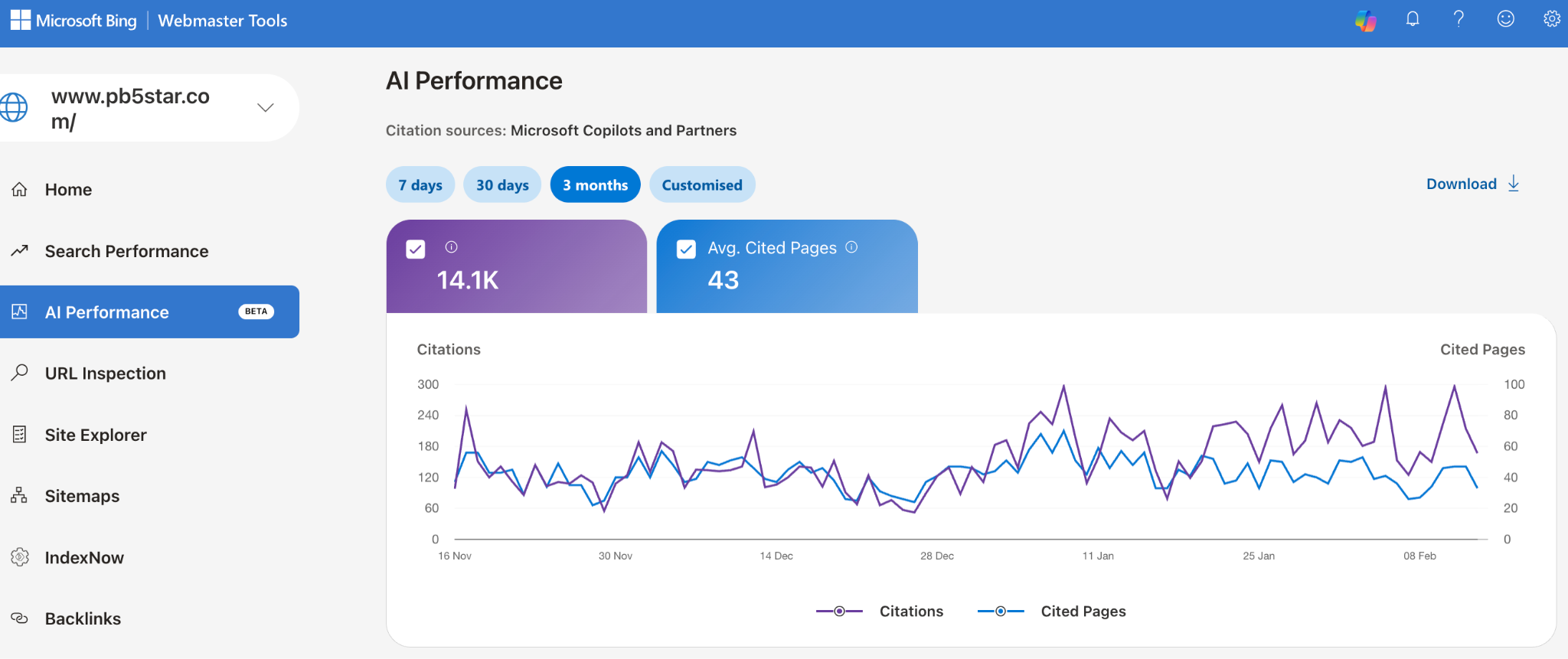
In February 2026, Bing rolled out a new AI Performance report inside Bing Webmaster Tools. It shows how often your content is cited inside Bing’s AI experiences and which grounding queries the AI uses to find you. (blogs.bing.com)
At the same time, independent researchers have shown that Google is already embedding grounding URLs, entity IDs, and passage‑level data for AI Overviews directly into the HTML of result pages—even when no AI block is visibly shown. (linkedin.com)
Put together, this is our first clear window into how AI systems select, ground, and cite web content.
This article will:
Explain what’s actually in Bing’s new AI Performance report
Demystify grounding queries and why they matter
Show how hidden code in Google and Gemini mirrors the same concepts
Walk through how FOMO.ai used this approach to drive thousands of AI citations for PB5Star
Inside Bing’s New AI Performance Report
The AI Performance section of Bing Webmaster Tools focuses on how your site appears inside AI‑generated answers rather than classic blue links. (blogs.bing.com)
Key elements include:
1. Total AI citations
How many times your URLs were displayed as cited sources in AI answers across Bing and Copilot over your selected date range. This is your AI visibility metric, separate from impressions or clicks.
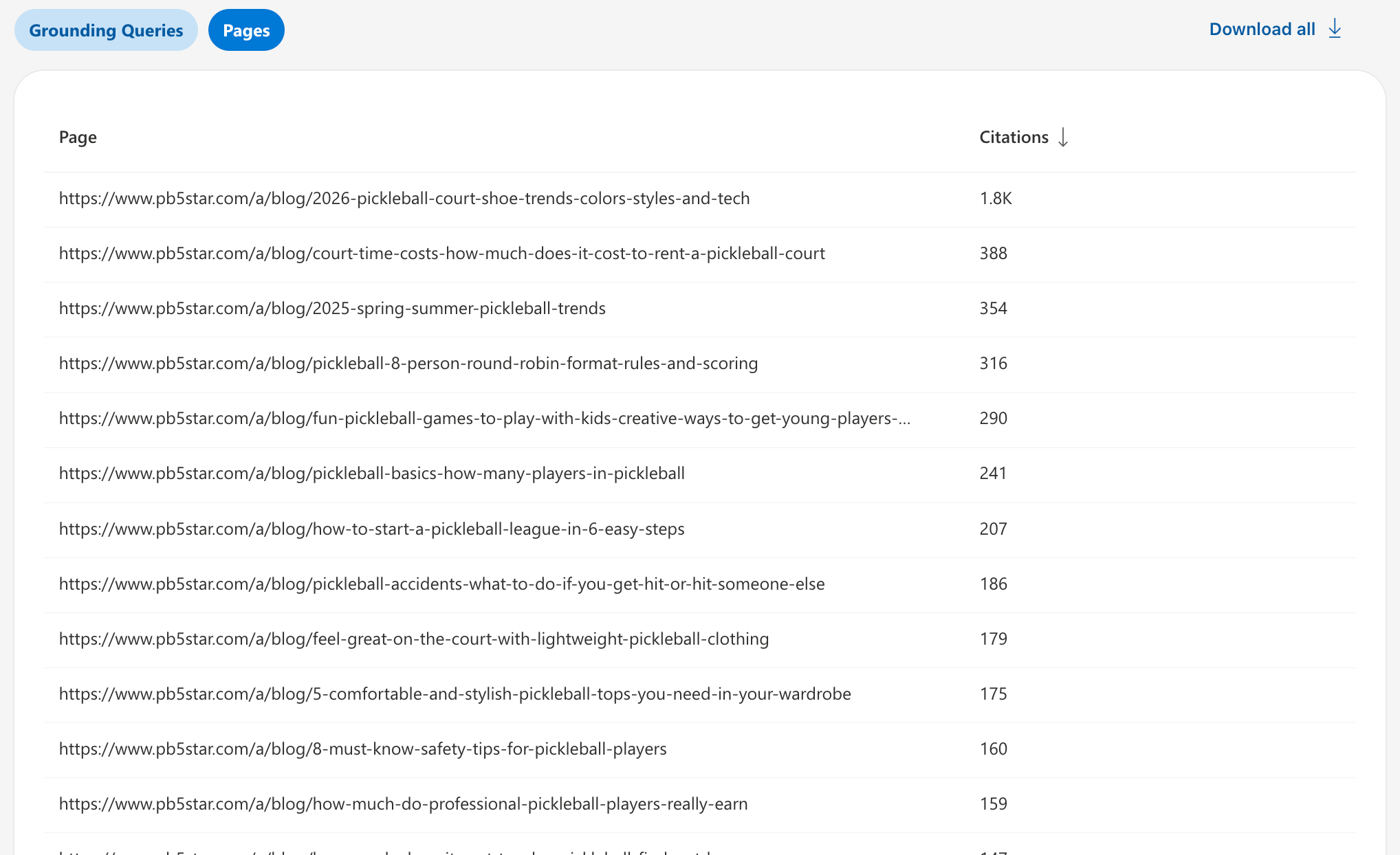
2. Cited pages
A breakdown of which URLs on your site are being cited and how often. In most early accounts, a small number of “hero” pages drive a large share of total citations. (joeyoungblood.com)
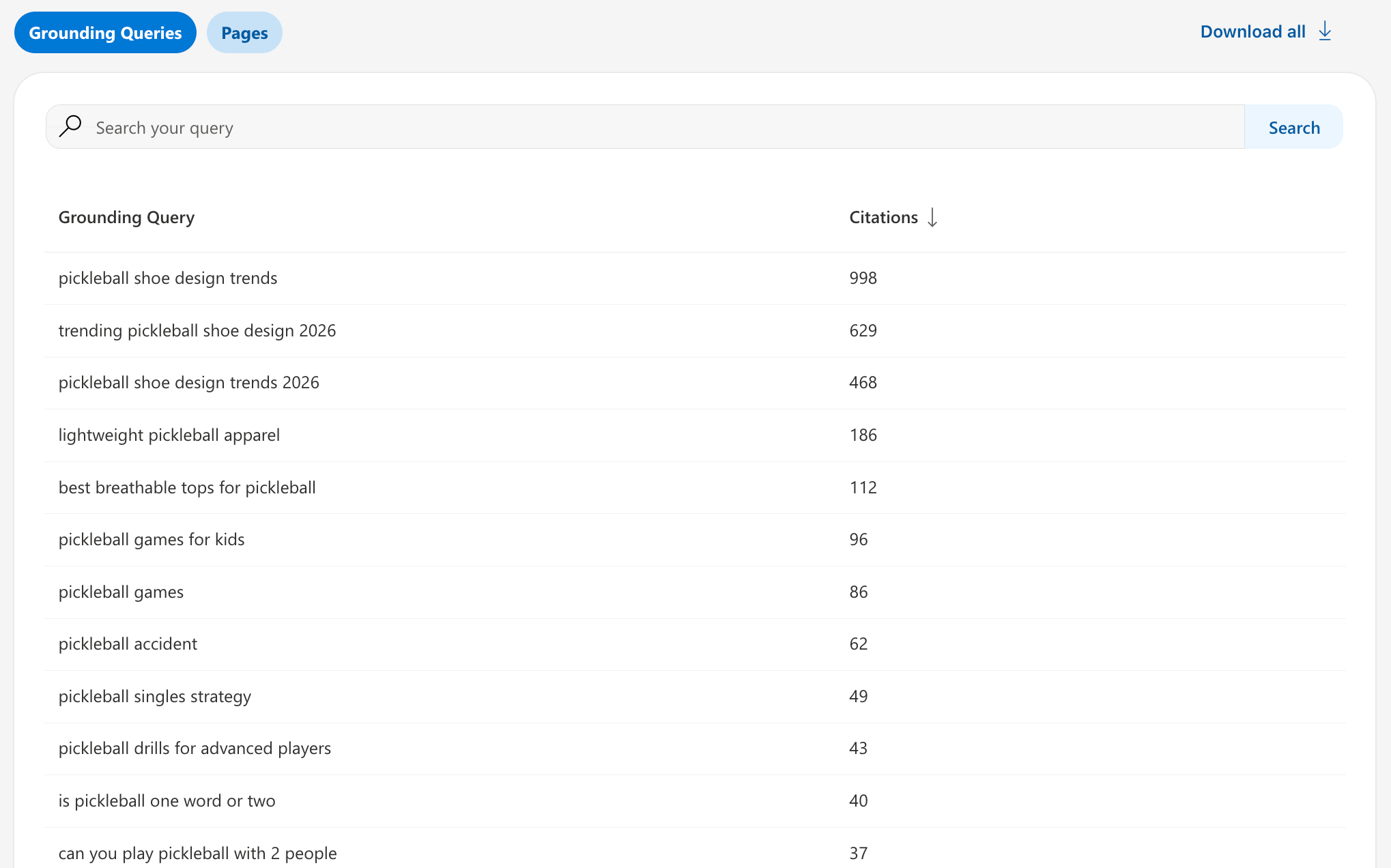
3. Grounding queries
These are the phrases the AI used internally when retrieving content that ended up in an answer. Microsoft describes them as the queries AI generated to find and ground your content, not necessarily the exact words the user typed. (blogs.bing.com)
4. Trends over time
Time‑series graphs that show whether your AI citation footprint is growing or shrinking, with up to months of historical data available in some properties. (linkedin.com)
Microsoft also recommends specific best practices for improving AI visibility—emphasizing structured, well‑cited, and fresh content with clear entities and helpful formatting (tables, lists, FAQs). (blogs.bing.com)
What Grounding Queries Really Are
To use this data, you have to understand grounding.
When a user asks an AI assistant:
“What are the 2026 trends in pickleball shoes?”
two layers of queries exist:
User prompt – the natural‑language question in the UI.
Grounding queries – the internal search queries the AI spins up to fetch supporting evidence.
Those internal queries might look more like:
“pickleball shoe design trends 2026”
“best pickleball shoes 2026 lateral stability”
Bing’s AI Performance report surfaces a subset of these grounding queries whenever your site is actually used as a source. (blogs.bing.com)
We see the same pattern elsewhere:
Google’s Gemini API exposes groundingMetadata, which includes:
webSearchQueries – the exact queries run to fetch sources
groundingChunks – URLs/content pieces retrieved
groundingSupports – how answer spans map back to sources (ai.google.dev)
Research into “query fan‑out” shows models generate multiple specialized queries from a single prompt to cover definitions, comparisons, and fresh stats. (surferseo.com)
In other words:
Grounding queries are the AI’s keywords—its machine‑optimized understanding of what it needs to look up to answer a user.
Traditional SEO optimizes for what people type. AI‑era SEO must additionally optimize for the queries models generate.
The Hidden Grounding Layer in Google’s Code
While Bing now provides a clean UI, Google already hints at similar structures in its own results—even though there’s no dedicated dashboard yet.
Reverse‑engineering of AI Overviews and AI Mode reveals that Google embeds rich grounding metadata in the HTML and scripts of result pages: (linkedin.com)
Researchers have documented:
Grounding URL lists – sets of URLs considered for grounding, including some that never show in the visible AI block.
Passage‑level pointers – text fragments and anchors (#:~:text= style) that mark which parts of a page the AI relied on.
Entity IDs (MIDs) – Knowledge Graph identifiers connecting brands, products, people, and places to the answer.
Section mapping – internal section labels tying specific answer chunks to specific grounding sources.
On the developer side, Google’s Gemini API makes this even more explicit in structured JSON via groundingMetadata. (ai.google.dev)
The same basic architecture appears in many AI stacks:
Generate grounding queries
Retrieve candidate URLs/content chunks
Map answer spans back to those sources
Bing is simply the first to expose that telemetry at the site level for SEOs.
How SEOs Can Use AI Performance Data Right Now
Here’s a practical way to turn Bing’s AI Performance report into a content advantage.
1. Treat grounding queries as AI‑native keyword research
Export your grounding queries and:
Cluster them by topic, entity, and intent
You’ll often discover phrasing that’s more concise and intent‑dense than classic keyword tools show.
Compare them to your current keyword sets
Identify gaps where AI grounding queries exist, but you don’t have focused content.
Refine content around them (without stuffing)
Use grounding phrases in:
H1s and H2s
FAQ questions
Table headings and captions
Aim for clear, direct phrasing that mirrors how an AI would summarize the topic.
This aligns your content with what models actually ask search engines for, not just what humans type.
2. Strengthen and scale your “hero” cited pages
From the page‑level citation table:
Find the pages with the highest citation counts.
For each, tighten your AI‑friendly fundamentals: (blogs.bing.com)
Up‑to‑date facts, stats, and examples
Clear sections, bullets, and mini‑summaries
Strong entity clarity (products, brands, locations) plus schema
FAQs that mirror real user and grounding questions
Then build supporting content around those pages—deeper how‑tos, comparisons, and related questions—linked tightly as a topical cluster. When models fan‑out queries across that topic, they’re more likely to land somewhere in your ecosystem.
3. Fix pages that rank but don’t get cited
If a page ranks in organic Bing or Google results but barely appears in AI citations:
Check: does it answer one focused problem per section, in 40–60 word passages that an AI can lift cleanly?
Add explicit micro‑answers and FAQs, and remove filler that buries the point.
Strengthen evidence and originality—unique data, frameworks, or examples that make your page the best grounding candidate for that question. (journaldunet.com)
Re‑check AI Performance after you update and ping Bing via IndexNow to speed up recrawling. (blogs.bing.com)
PB5Star: A Concrete Example of Grounding‑Led Content Strategy
PB5Star, a performance pickleball footwear and apparel brand, is a live case of how this plays out.
Looking at their Bing AI Performance data, FOMO.ai sees:
Top cited pages (sample):
2026 pickleball court shoe trends, colors, styles & tech – 1,662 citations
Court time costs – how much it costs to rent a pickleball court – 387
2025 spring/summer pickleball trends – 351
Round‑robin formats, kids’ games, rules basics, safety tips, earnings of pros, and more, each with 90–350+ citations
Top grounding queries (sample):
“pickleball shoe design trends” – 948 citations
“trending pickleball shoe design 2026” – 595
“pickleball shoe design trends 2026” – 407
Plus apparel, safety, rules, and cost queries like “lightweight pickleball apparel,” “pickleball accident,” “is pickleball one word or two,” “pickleball cost,” and “pickleball singles strategy.”
When you read PB5Star’s 2026 shoe trends article, the alignment is obvious: (pb5star.com)
The headline and intro lock onto year + category + intent (“2026 pickleball court shoe trends”).
The article breaks trends into clear, scannable sections (color palettes, materials, tech features, on‑court performance).
The brand’s proprietary tech (like Dynamic Stability Assist) and hero products (e.g., the Cosmic shoe) are described in ways that map cleanly to entities.
FAQ‑style Q&As at the end mirror the way both users and models frame questions about shoes, comfort, and performance.
This is the FOMO.ai pattern:
Start with question‑driven topics mapped to real and anticipated grounding queries.
Build topical clusters (trends, costs, rules, formats, apparel, safety) instead of isolated posts.
Structure content for machine readability—sections, bullets, and mini‑answers that can be quoted directly.
Ensure strong entity and brand linkage, so when the AI grounds “pickleball shoe design trends 2026,” it keeps returning to PB5Star as a reliable authority.
The result is thousands of AI citations across a wide range of pickleball‑related questions—not just about shoes, but about the sport’s rules, safety, and culture as well.
From Rankings to Reasoning: What This Shift Really Means
Traditional SEO measured success in ranking positions and clicks.
Bing’s AI Performance report, Google’s hidden grounding data, and Gemini’s APIs all point to a new reality:
AI systems maintain their own internal maps of trusted sources and entities.
They express that trust through grounding queries, selected URLs, and citation patterns.
Those patterns are now measurable and inspectable—both via dashboards (Bing) and code/API analysis (Google/Gemini).
If you want to survive this shift, your content strategy can’t stop at “ranking for keywords.” It must:
Anticipate and serve grounding queries
Provide clear, extractable answers at passage level
Establish your brand as a reliable entity around specific topics
Use tools like Bing’s AI Performance to create a closed feedback loop between what AI is actually doing and what you publish next
That’s the core of AI search authority: not just being seen, but being consistently used inside the reasoning of the models your customers rely on.